Banana slugs at the Summer Institute

Linguists from UC Santa Cruz are well represented at the 2023 Linguistic Society of America Summer Institute, which is taking place June 19-July 14 at the University of Massachusetts, Amherst.

Rising second year PhD student Richard Wang is in attendance, after receiving a highly selective Linguistic Institute Fellowship.

Professor Matt Wagers is co-teaching a course on Field Psycholinguistics, with PhD alumnus Jed Pizarro Guevara (PhD 2020), who is currently a postdoctoral researcher at UMass.

Other banana slugs in attendance include Professor Eric Bakovic (BA, 1993), who is teaching a course on What Exactly is Phonological Opacity, Professor Kyle Rawlins (PhD, 2008), who is teaching a course on Advanced Pragmatics, and Professor Aaron White (BA, 2009), who is teaching a course on Representation Learning for Syntactic and Semantic Theory.
Walker in Nijmegen

On June 1, Professor Rachel Walker presented a paper on “Metaphony and asymmetric positional activity” at the Phonetics and Phonology in Europe (PaPE) satellite workshop on “Metaphony: Theoretical, Descriptive, and Typological issues” at Radboud University in Nijmegen. She was also a co-organizer of the workshop. Aaron Kaplan (PhD, 2008), currently Associate Professor at the University of Utah), was also in attendance, giving an invited talk on “Prominence conflicts in Bolognese.”

Bennett at HISPhonCog

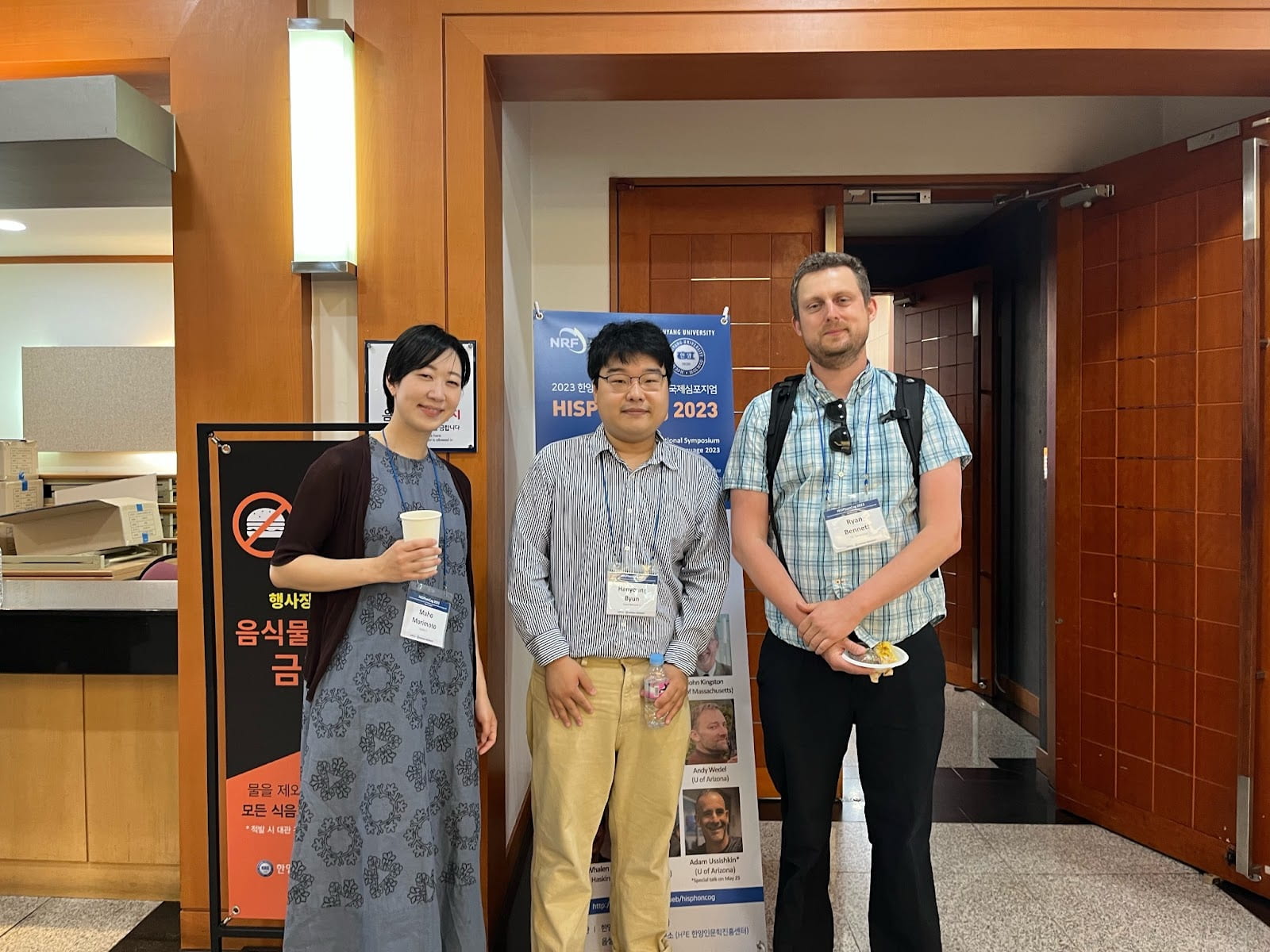
Last week, Professor Ryan Bennett presented a talk at HISPhonCog in Seoul, entitled “Syllable position in secondary dorsal contrasts: an ultrasound study of Irish.” While there, he had the opportunity to catch up with some past and future students in the department. Maho Morimoto (PhD, 2020) also presented at the conference, and incoming PhD student Hanyoung Byun was in attendance as well.

HisPhonCog

Maho Morimoto, Hanyoung Byun, Ryan Bennett (from left to right)

Chung on YouTube

PulanSpeaks is a Guam-based YouTube-channel devoted to the creating and sharing of video discussions of cultural and political issues affecting Pacific island cultures and communities. It is hosted by Edward Leon Guerrero, who became a cultural and language activist as an undergraduate at the University of Guam. In the most recent installment of PulanSpeaks (April 15th), Guerrero hosted Professor Emerita Sandy Chung in a discussion of her career-long commitment to the study of the Chamorro language (or Chamoru as it is known in Guam), and of the character, origin, and history of the language. They also consider the issues that the language currently faces in the Mariana Islands, and the history of her own involvement with the language and its communities. 

Toosarvandani at UCLA

This past Friday, Professor Maziar Toosarvandani gave a colloquium in the Department of Linguistics at UCLA. His talk on “Representing animacy in the grammar”, reported some recent results relating to the ongoing NSF funded project on animacy and resumption. The abstract for his talk is below:

We are used to thinking about person, number, and gender as features to which the grammar is sensitive. But the place of animacy is less familiar, despite its robust syntactic activity in many languages. I investigate the pronominal system of Southeastern Sierra Zapotec, identifying an interpretive parallel between animacy and person. Third person plural pronouns, which encode a four-way animacy distinction in the language, exhibit a cluster of interpretive properties I call “associativity”; these have been argued also to characterize first and second person plural pronouns. Building on Kratzer’s (2009) and Harbour’s (2016) theories of person, I propose a plurality-based semantics for animacy that captures their shared properties. The compositional mechanism underlying this semantics ties person and animacy features to a single syntactic position inside the noun phrase. This enables an understanding of these features’ shared relevance to syntactic operations, including those underlying pronoun cliticization.

While down south, Maziar had the opportunity to catch up with fellow Oto-Mangueanist Ben Eischens (PhD, 2022), who is now on the linguistics faculty at UCLA.

From Junko and Armin: A little report on our African safari tour

Professors Junko Ito and Armin Mester recently returned, in February, from a safari tour. They had the following report to share with the WHASC Editor:

After a grueling 20-hour flight to Johannesburg, South Africa, we started our three-week African tour, staying in safari camps in Zimbabwe, Zambia and Botswana. Spectacular game-viewing drives on jeeps — exhilarating scenery and closeby roaming wildlife (elephants, giraffes, lions, etc.).  One of the highlights was a boat expedition on the Zambezi river, with Victoria Falls on the horizon, where several hippos decided to chase our boat. We managed to do some field work with one of our safari guides, who was a speaker of Ndebele, a Bantu click language.  We were fortunate in coming across a small herd of endangered white rhinos — which turned out not to be “white” at all, but “wide-mouthed” (vs. the “pointed-mouth black rhinos”)  — a curious linguistic misinterpretation (and resulting misnomer) amongst the Dutch and English settlers in South Africa. Yes, final devoicing can have real-life consequences!

Junko Ito on the Safari

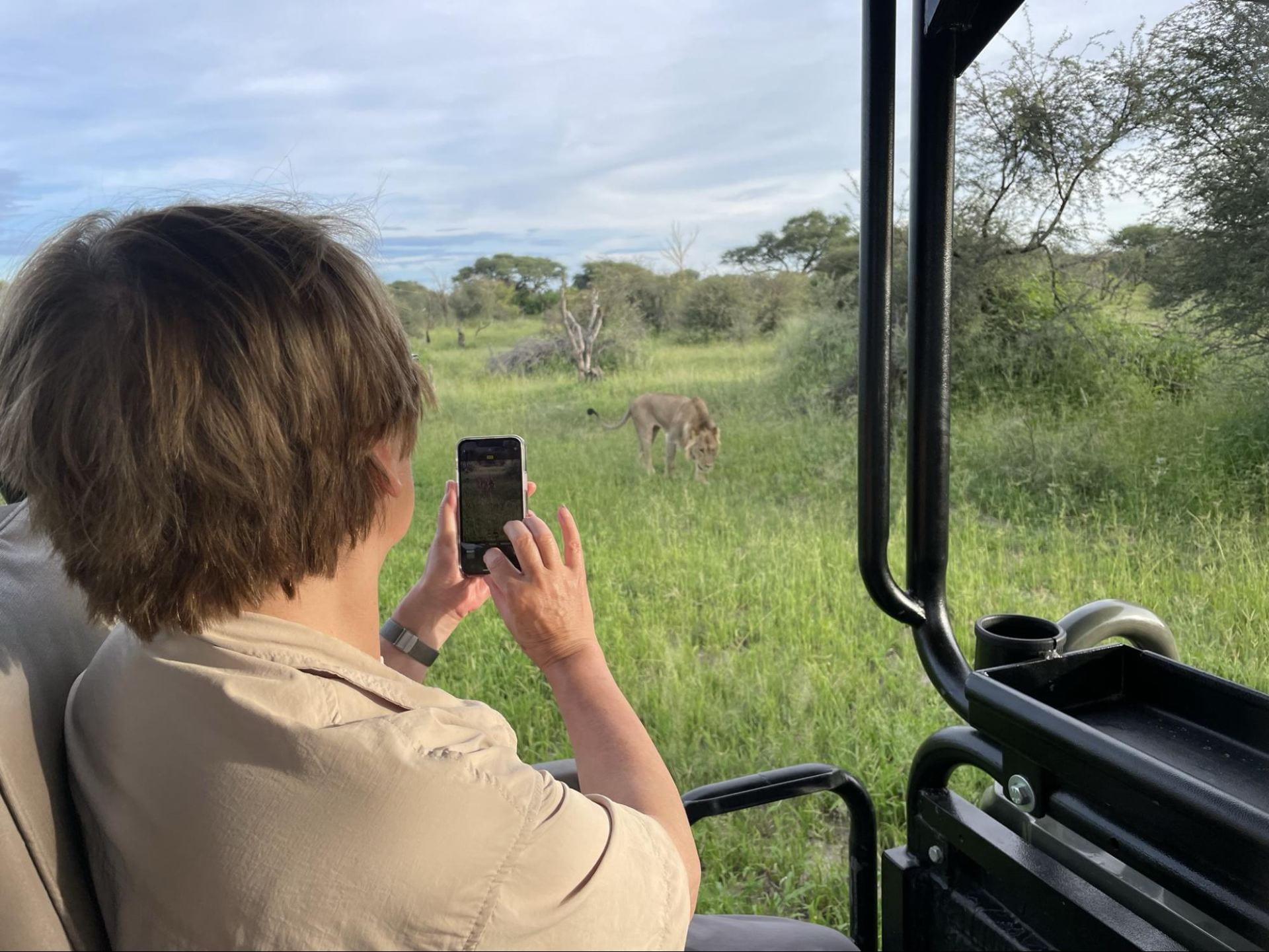
Professor Junko Ito encounters a lion


UCSC Linguists at the 2023 LSA Linguistic Institute

The 2023 LSA Linguistic Institute, “Linguistics as Cognitive Science: Universality and Variation,” will be held June 19-July 14 at the University of Massachusetts, Amherst. Two of the Institute’s courses will be taught by UC Santa Cruz faculty or alumni: Field Psycholinguistics (course 220) will be taught by Professor Matt Wagers and Jed Sam Pizarro-Guevara (PhD, 2020) and Advanced Pragmatics (course 211) will be taught by Maria Biezma and Kyle Rawlins (PhD, 2008).

1 8 9 10 11 12 56